

Over the years, the WWF had implemented a complex segmentation scheme, totaling more than forty segments, some of which had cumbersome and quite unusual definitions (e.g., “Annual regular who made last donation eight to fifteen months ago.”). It was also sending many solicitations. For some segments, it could go up to thirteen or fourteen mailings per year, in addition to regular email communications.
Our analyses revealed that some donors the WWF considered the “cream of the crop” were assigned to very low-scoring classes and deemed unprofitable by our donor qualification scoring model. For example, because the average donation amount was barely taken into account in the original segmentation scheme, an individual who had donated $5 twice a year for the past decade was classified in one of the most valuable segments. Such individuals received thirteen newsletters and fundraising campaigns per year, which, in total, cost more than what that donor would contribute over the course of an entire year. The most significant impact the scoring had on the Nature Foundation’s fundraising was the reduced number of solicitations, cutting the scope of some campaigns in half.
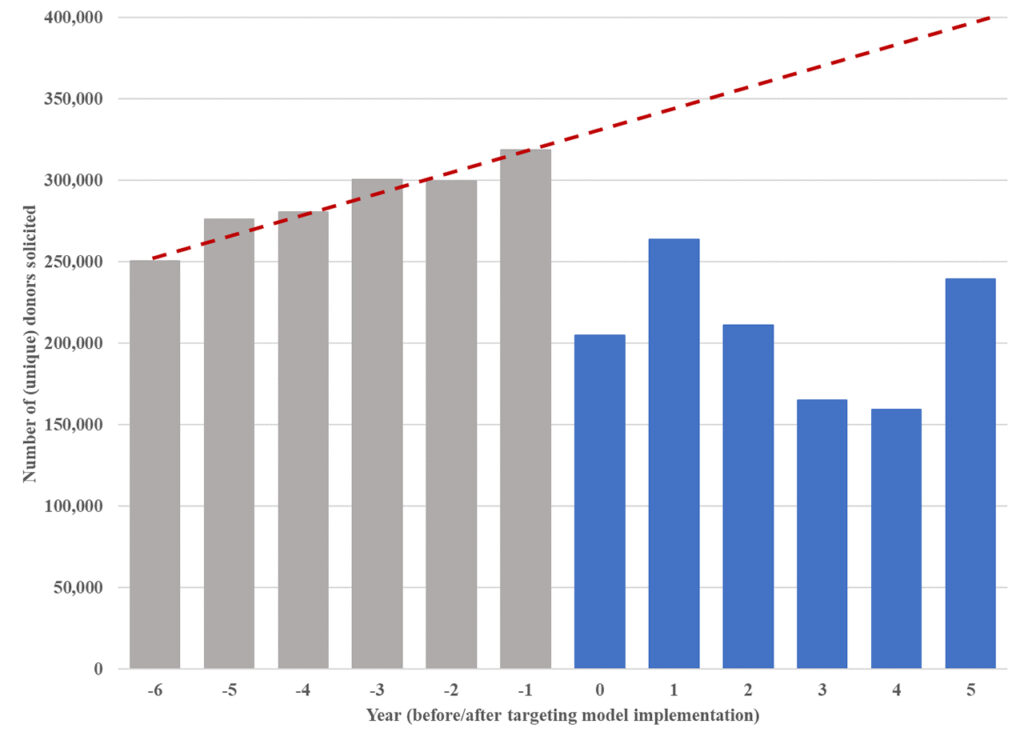
For the six years prior to the implementation of the targeting model, gross revenues had increased by 17.5% (an annual growth rate of 3.3%), while the number of solicitations had increased by 27.3% (an annual growth rate of 4.9%). Over the first six years of implementing the endogeneity-controlling model, the organization’s gross revenues grew by +21.0% at an annual rate of 3.9%.
More significantly for the organization, while slightly accelerating its growth, the total number of solicited individuals dropped significantly due to much better-targeted campaigns, as shown below. This dramatically improved the profitability of their fundraising campaigns and freed up a significant portion of their budget for more productive initiatives.